Get Marketing Insights First
Subscribe to receive actionable strategies, growth tips, and industry insights delivered straight to your inbox.

Upgrading rental apartment lighting doesn't require an electrician — warm-toned LED bulbs, added table and floor lamps, a plug-in dining pendant, and smart bulbs cover 95 percent of what makes lighting feel intentional.
Quick Answer
You do not need an electrician to meaningfully upgrade the lighting in a rental apartment. The most impactful changes — replacing bulbs with warm-toned LEDs, adding table and floor lamps, installing a plug-in pendant over the dining table, using smart bulbs to control warmth and dimming — require no wiring, no permits, and no landlord approval. They also take the lighting from functional to intentional in an afternoon.
In This Article
Quick Takeaways
The first lighting upgrade in any rental apartment costs approximately $15 and takes twenty minutes. Buy enough warm white (2700K) LED bulbs to replace every bulb in the apartment. Install them. Stand back and assess the difference. If the before is a cool blue-white light that reads as institutional and harsh, the after is a warm amber-toned light that reads as domestic and considered.
The 2700K specification is the key number. Most rental apartments come with whatever bulb was cheapest at the time of installation — often a cool 3000-4000K daylight bulb that is efficient but emotionally flat. The 2700K standard matches the warmth of traditional incandescent bulbs. It is the temperature of candlelight-adjacent light, and it makes everything in a room look better: skin tones, food, artwork, and furniture all benefit.

The golden rule of interior lighting design is the layered light approach: every room should have at least three light sources at different heights — overhead (ambient), mid-height (task or accent), and low (accent or mood). Rental apartments typically provide only one of these: the overhead. The renter’s job is to add the other two.
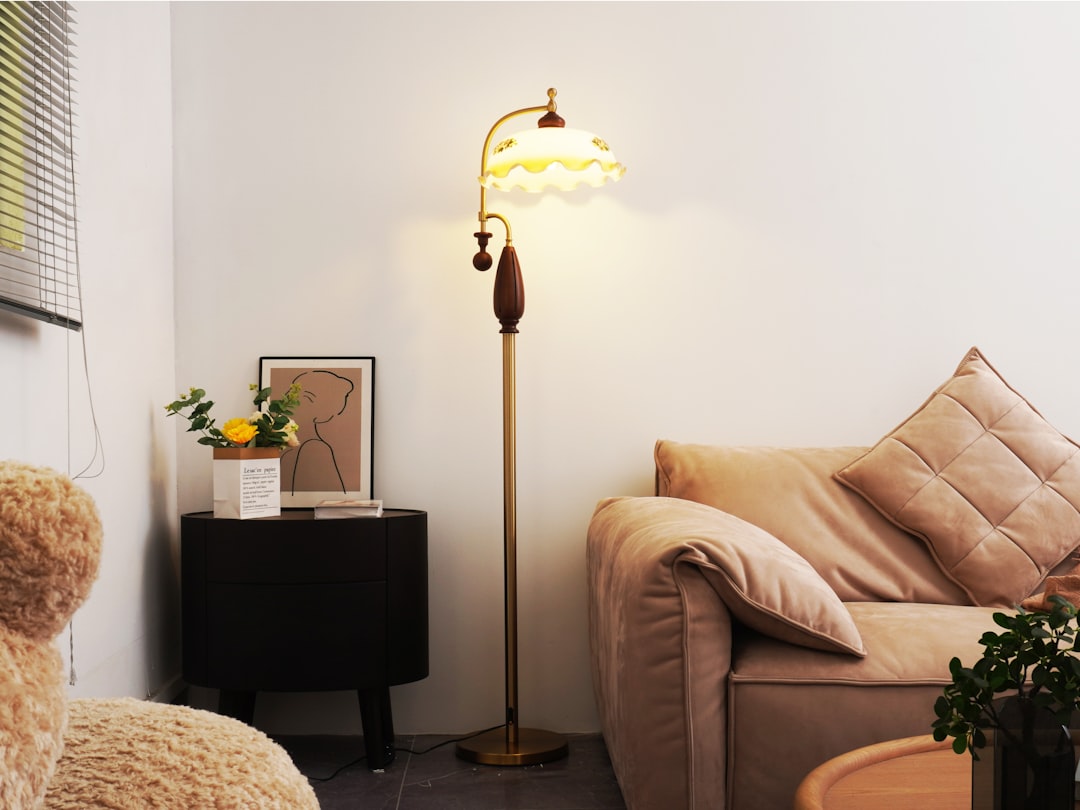
For a living room: one floor lamp (either arc or standard torchiere style, positioned behind or beside the sofa to wash the ceiling with indirect light), one table lamp on a side table or console (for warm directional light in the seating zone), and the overhead (for general illumination when needed, switched off when the other two are on). These three sources create a room that can operate in multiple modes.

A plug-in pendant is an overhead pendant light that runs on a cord to a standard outlet rather than requiring a wired ceiling junction box. Combined with an adhesive ceiling hook rated for the lamp’s weight, it creates the look of a professionally installed pendant at a fraction of the cost and without a single modification to the electrical system.
The most common application: over the dining table. Most rental dining areas have only an overhead light centered in the room, which is rarely centered over the table itself. A plug-in pendant hung directly over the table — on a ceiling hook positioned precisely where you need it — is one of the most transformative single improvements possible in a rental apartment. It immediately defines the dining zone, improves the light quality directly over the food, and photographs as a genuine design decision.
Smart bulbs — specifically Philips Hue, LIFX, or the more affordable Govee and Sengled options — allow you to control both the color temperature and the brightness of your lights from a phone app or voice assistant. This means you can have warm, dim living room lighting at 8pm and bright, neutral bathroom lighting at 7am from the same light bulbs, without touching a dimmer switch or buying additional hardware.
For renters, the particular advantage is the ability to dial in the exact warmth and brightness for different times of day and different activities without any wiring. Movie mode, dinner mode, reading mode, and morning mode can all be saved as scenes and activated with a tap. The initial investment is higher than standard LEDs — approximately $15-25 per bulb — but for the fixtures you use most, the functionality justifies it.
Understanding what goes wrong in rental lighting is as useful as knowing what to add. These are the most common errors, and fixing any one of them will measurably improve the apartment.
This requires electrical work and in most cases landlord permission. However, plug-in alternatives exist for both: plug-in pendants for ceiling lights, and freestanding tower fans for circulation. Check your lease before touching any ceiling fixture, even a simple bulb replacement in a fixture with a decorative shade.
The Govee smart bulbs offer good color temperature range (2700K-6500K) and brightness control at approximately $7-10 per bulb when bought in multi-packs. They connect via Wi-Fi without a hub and are controllable via app and voice assistant. For higher quality and reliability, Philips Hue remains the gold standard but at 3x the per-bulb cost.
Add a warm-toned LED mirror. These mount to the wall with adhesive strips or light screws (check the weight rating) and provide illumination at face level — exactly where bathroom light should come from for grooming. This single addition transforms bathroom lighting more than any other change available to renters.
The bottom of the shade should be 28-34 inches above the table surface for standard 8-foot ceilings. For 9-foot ceilings, 30-36 inches. The goal is light that illuminates the table and the faces of people sitting around it without the shade being in anyone’s eyeline during conversation.
Get damage-free décor ideas, budget tips, and exclusive finds delivered to your inbox.
We respect your privacy. Unsubscribe anytime.